
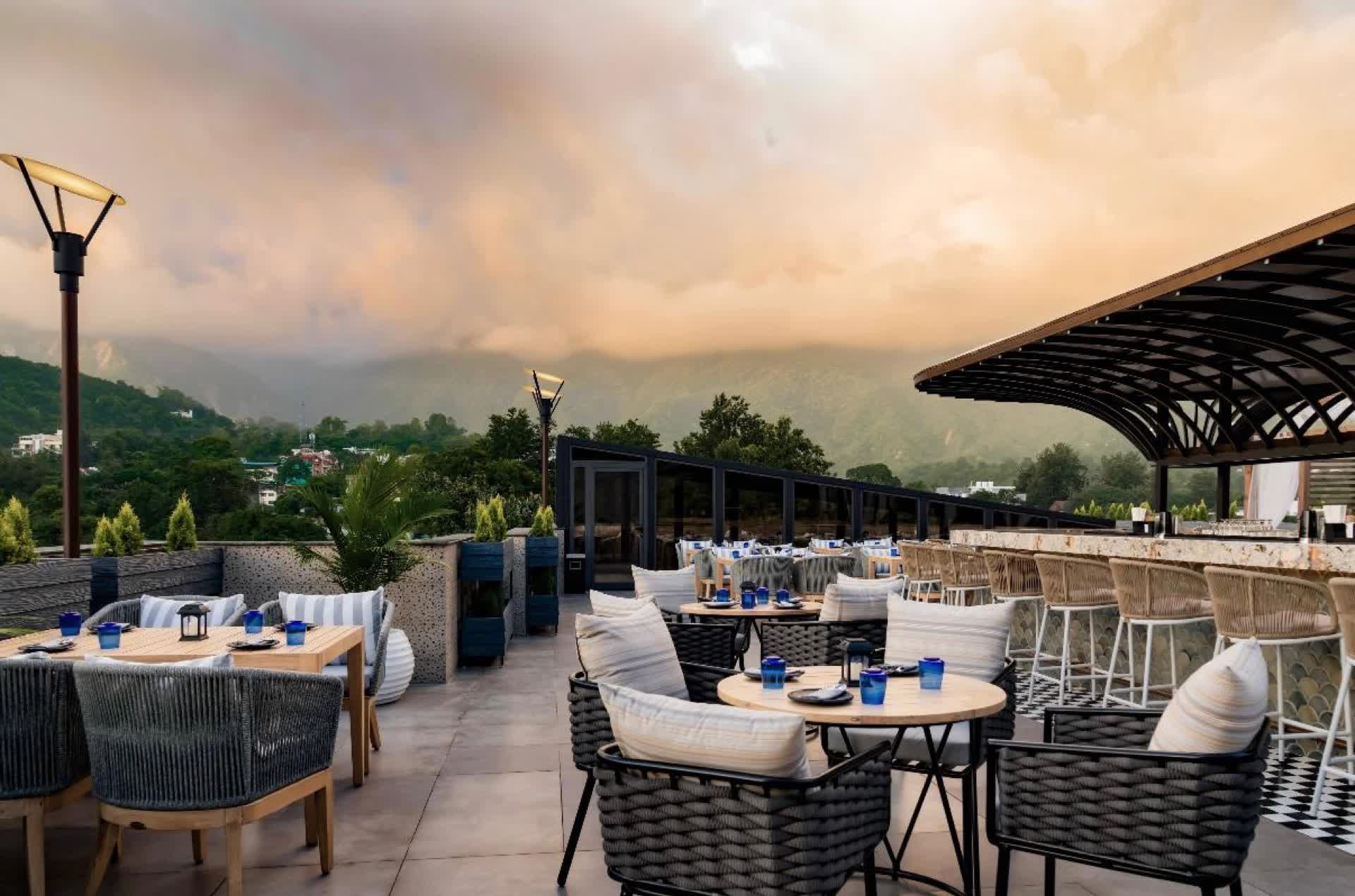
In Mumbai, a rooftop is a way to escape the street. The view from up there is more rooftops. The point is to be above the noise. In Delhi, a rooftop is a status, height confers privilege, the higher the better.
In Dehradun, a rooftop is a way to see. To see the Doon Valley below. To see Rajpur Road's old colonial trees. To see the Mussoorie hills rising 30 kilometres north, sometimes close enough to feel, sometimes far enough to dream about. A Dehradun rooftop is not above the city, it's an angle on the city's defining feature, which is what's outside the city.
This is the case for rooftop dining in Dehradun. Below is the longer argument.
What you see from a Doon rooftop
From the Farzi Café terrace on a clear day in October, you can see four things:
- The Doon Valley, green, low-slung, dotted with red-tile roofs.
- The first hills, the green ridges that start about 8 km out, sometimes wrapped in mist by 4 PM.
- Mussoorie itself, a thin band of buildings perched 2,000 metres up, lit at night like a string of beads.
- The snow line, on rare winter mornings, visible behind Mussoorie, the high Himalayas casually announcing themselves.
That's the canvas. Now imagine watching the sun drop behind that canvas at 6:25 PM in May. The sky goes pink. The hills go violet. The lights in Mussoorie come on one by one, like someone is hand-lighting candles 30 kilometres away. It takes about 25 minutes from "the sun is still up" to "it's blue dark," and you don't want to be anywhere else for those 25 minutes.
The temperature argument
Dehradun sits at 640 metres. That's not "mountain" altitude but it's enough that evenings are 4-5°C cooler than the same evening in Delhi, year-round. In May, when Delhi is unbearable, Dehradun rooftops are pleasant. In December, they're cold but heated, which is more atmospheric than the indoor alternative.
The temperature is why Dehradun rooftops work as outdoor spaces eight months of the year, not three.
What makes a Dehradun rooftop different from a Goa rooftop
Goa rooftops are about the sea. Dehradun rooftops are about the hills. The sea is constant, same horizon every day. The hills change. Monsoon makes them green. Winter makes them blue. Summer evenings dust them in haze that turns the sunset into a watercolour. The rooftop is the same; the show changes.
The five sunsets we won't forget at Farzi Café
We've been watching from the same terrace for a few months now. A few sunsets have stayed:
- The post-monsoon clarity sunset, September. First clear evening after three weeks of rain. The hills came back like someone had turned up the saturation. The whole rooftop went quiet for ten minutes.
- The winter snow-line sunset, January. One morning the snow appeared behind Mussoorie. By evening it was still there. The sunset that night was the most dramatic backdrop we've seen, orange foreground, white middle, blue back.
- The thunderstorm-half-light sunset, May. A storm coming down the valley. The sky split in two, bright sunset on the left, black thunderclouds on the right. We didn't sell a single drink for 20 minutes because everyone was looking up.
- The lychee-season sunset, June. The Doon Valley lychee orchards were heavy. The air smelled faintly sweet at 6 PM. The sunset that night turned everything gold and the bar smelled like fruit. Surreal.
- The Diwali sunset, November. Sunset behind Mussoorie, fireworks starting in the city below as it went dark. We're never doing that night without a full house again.
How to actually plan your rooftop sunset
If you want to do this properly:
- Reserve. Open-terrace tables for sunset slots (6 PM / 6:30 PM) fill several days in advance. WhatsApp is the fastest way: +91 76177 71124.
- Arrive 45 minutes before sunset. The light starts working about 30 minutes before. You want to be settled with a drink in hand.
- Pick the terrace. Not the cabana, not the bistro indoor. The open terrace, west-facing.
- Order a slow drink. A Saffron Sour, an Old-Fashioned. Not something fizzy that you'll finish in 5 minutes.
- Put the phone down. Take one picture if you must. Then put it down.
For the full guide to rooftop café options across Dehradun, see our Rooftop Café in Dehradun page.
Planning your rooftop evening
The single biggest variable on any rooftop in Dehradun is the sunset, and it moves by nearly 90 minutes between the shortest and longest days of the year. Here is the season-by-season arrival guide for the Farzi Café terrace.
- Summer (April–June)
- Sunset falls behind the Mussoorie hills around 6:50 PM. Arrive by 6:00–6:15 PM. The pre-sunset light starts working about 30 minutes before the drop; you want a drink in hand before that begins. These are the longest, warmest evenings of the year, the terrace is at its most social, and rooftop tables book out several days in advance on weekends.
- Monsoon (July–September)
- The open terrace gives way to the floor-to-ceiling glass bistro, which operates as a fully enclosed indoor space with unobstructed hill views. The restaurant runs year-round; monsoon evenings behind the glass, Mussoorie clouds rolling in, rain on the valley below, are their own kind of theatre. Arrive any time after 6 PM; sunset visibility is rain-dependent.
- Post-monsoon and autumn (October–November)
- The terrace reopens and the hills are at their greenest after weeks of rain. Sunset arrives earlier: aim for 5:00–5:15 PM arrival, with the sun dropping around 5:30–5:45 PM. October is the clearest month, on good days you can see the snow line behind Mussoorie. The Diwali sunset in November, with fireworks starting in the city below as the sky goes dark, is an annual event the team waits for.
- Winter (December–March)
- Sunset is around 5:30 PM at the shortest-day end. Arrive by 5 PM. The terrace is open but colder, bring a layer. On clear January and February mornings, the high Himalayan snowline is visible behind Mussoorie. Evening temperatures on the terrace can drop to 8–10°C by 7 PM; the indoor bistro is heated.
The cabana guide
The six private cabanas along the northern edge of the rooftop are Farzi Café Dehradun's most requested space, and the most misunderstood. Here is what you need to know before you book.
- Capacity: Each cabana seats eight guests comfortably. They are designed for a group at a single table, not a couple wanting privacy.
- Minimum spend: ₹18,000 per cabana. This covers food and beverage; it is not a rental fee. A group of eight ordering a full dinner with cocktails will typically reach this without effort.
- Booking: Cabanas are not bookable via walk-in, reserve in advance by phone or WhatsApp at +91 76177 71124, or through the events page. Weekend cabanas go quickly in summer and during festival seasons.
- The experience: Each cabana is curtained on three sides, open towards the terrace and the hill view. After 9 PM the lighting shifts to warm amber and the cabanas become the most atmospheric seats in the house.
What to order up there
The rooftop terrace, especially at sunset, calls for food and drinks that work in hand, at conversation pace, without requiring full attention. These four are the right starting point.
- Saffron Sour, the house sundowner. Saffron-infused spirit, lemon, egg white, bitters. Slow and floral. Order this as the sun is still up.
- Mussoorie Hill Highball, named for the view. Light, long, herbal. The right drink for the 20 minutes after sunset when the sky is doing its best work and you don't want anything too demanding in your glass.
- Galouti on a Stone, the first course for the table. A seekh-style mince patty served on a heated river stone with mint chutney. Eat one between sips. It disappears fast.
- Dal Chawal Arancini, crisp on the outside, soft and deeply savoury inside, served with smoked tomato chutney. Genuinely excellent rooftop food, each ball is one bite and one moment of quiet appreciation. Read the full story behind the dish.
Frequently asked questions
Why is rooftop dining in Dehradun special?
What is the best time to visit a Dehradun rooftop for the sunset?
Reserve a Rooftop Sunset See the Rooftop
Related: Best cocktail bars in Dehradun · Things to do on Rajpur Road